
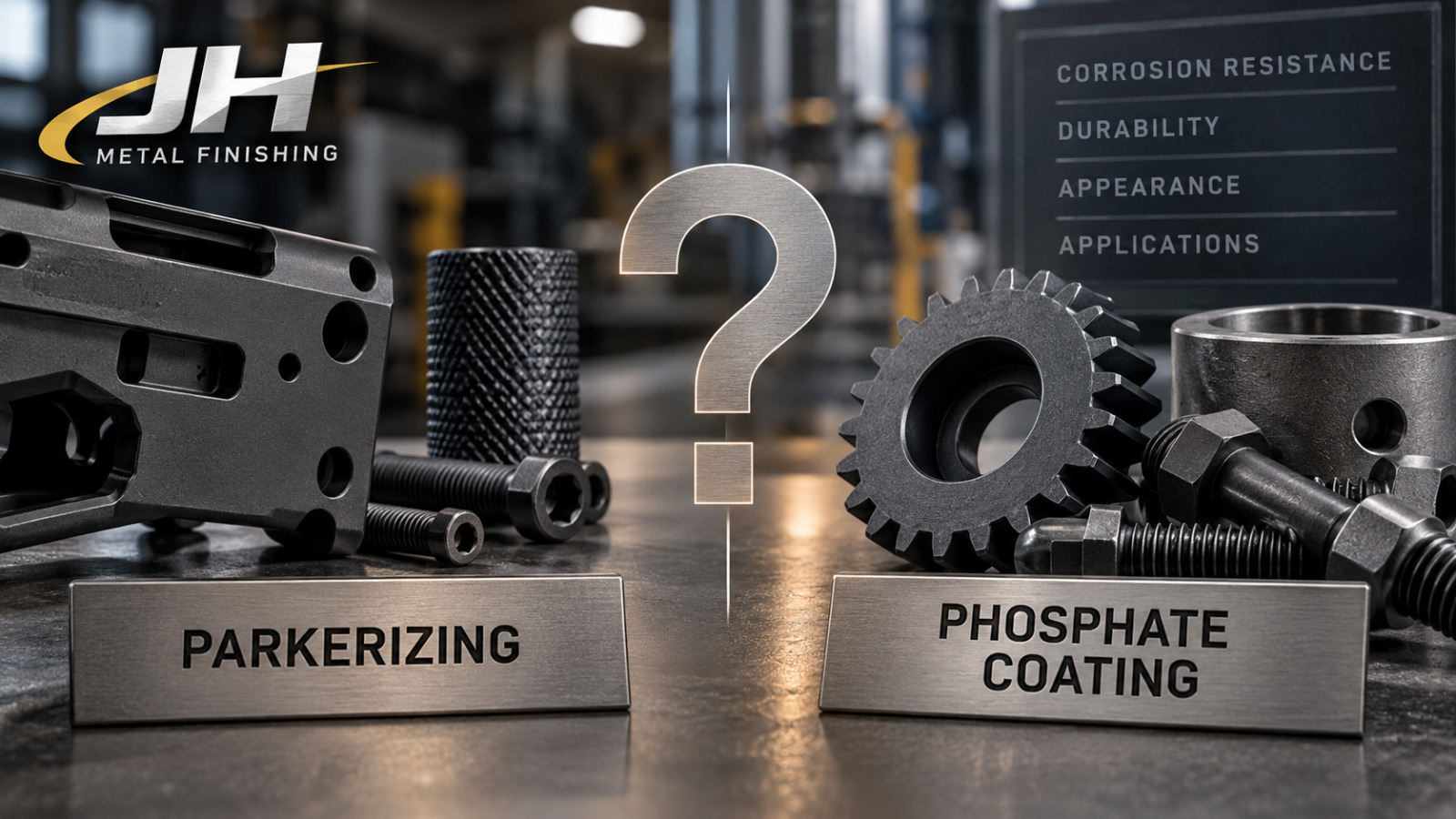
What Should You Know About Parkerizing and Phosphate Coating?
Parkerizing is a phosphate coating.
The name generally refers to zinc or manganese phosphate conversion coatings applied to steel.
Not every phosphate coating is Parkerizing.
Phosphate coating also includes iron phosphate, which most manufacturers would not describe as Parkerizing.
Manganese phosphate emphasizes wear resistance.
It holds oil well and helps reduce friction, galling, and break-in damage on moving components.
Zinc phosphate is commonly used for corrosion protection and paint preparation.
Its crystalline surface helps oils, primers, paints, and other topcoats adhere to steel.
Iron phosphate is mainly an economical paint base.
It is thinner and provides less wear and corrosion protection than manganese or zinc phosphate.
The coating’s performance depends heavily on its supplementary treatment.
Oil, wax, paint, or dry film lubricant fills the porous phosphate layer and provides much of the final protection.
“Parkerize” is usually too vague for a modern engineering drawing.
A complete callout should identify the phosphate chemistry, governing specification, type, class, and required sealer or preservative.
Legacy drawings can still be interpreted.
An experienced metal finisher can translate an older Parkerizing callout into the appropriate modern process and specification.
01.
How Does a Phosphate Conversion Coating Work?
If you work in manufacturing long enough, you will eventually see the same finish called two different things. A gunsmith calls it Parkerizing. An engineer writes “manganese phosphate per MIL-DTL-16232” on a drawing. A purchasing manager reads both and wonders whether they are ordering the same thing.
The short answer is yes, mostly, but the details matter. Parkerizing is a phosphate coating. It is an older, widely used name for a specific family of phosphate conversion coatings applied to steel. But the reverse is not always true. Not every phosphate coating is what most people would call Parkerizing, and knowing where the line falls can save you a confusing quote or a mismatched finish.
JH Metal Finishing runs into this distinction regularly. Operating from New Britain, Connecticut since 1953, JH applies zinc and manganese phosphate coatings to steel parts for defense, aerospace, automotive, and industrial customers, working to military and aerospace specifications such as MIL-DTL-16232 and AMS 2480 and 2481. Customers arrive with all sorts of language for the same process, and part of the job is translating between the vocabulary on an old print and the vocabulary a modern spec expects. So it is worth walking through what these terms actually mean.
02.
The short version
Phosphate coating is the broad, technical term. It describes a chemical process that grows a layer of iron, zinc, or manganese phosphate crystals on the surface of a steel part. That layer improves corrosion resistance, holds oil and lubricants, resists wear, and gives paint something to grab onto.
Parkerizing is a narrower, older name for that same idea. It comes from a specific company, it carries a history mostly tied to firearms, and it usually refers to the zinc or manganese versions of the process rather than the lighter iron phosphate version. So when someone says Parkerizing, they almost always mean a zinc or manganese phosphate coating. When someone says phosphate coating, they might mean that, or they might mean an iron phosphate finish that very few people would ever call Parkerizing.
The rest of this article is about why the two vocabularies exist and what you actually need to write down when you order a finish.
03.
Where the word “Parkerizing” comes from
The word is not a chemistry term. It is a brand name that stuck. Think Kleenex.
The underlying science predates the name. British inventors were patenting phosphating processes in the second half of the 1800s and into the early 1900s. William Ross filed an early phosphating patent in 1869. Thomas Coslett patented an iron phosphating process in Britain in 1906 and in the United States in 1907. An improved manganese phosphating process was patented in the United States in 1913.
The name entered the picture through Clark W. Parker, who acquired rights to those American patents and, with his son Wyman, founded the Parker Rust-Proof Phosphating Company of America in 1915. The company refined the process, made it faster and more practical for mass production, and attached its name to the result. Coat a steel part in a Parker phosphate bath, and you had “Parkerized” it.
The process found its defining application in firearms. Phosphate coating was tougher and more corrosion-resistant than the bluing that had come before, and it gave a non-reflective, matte surface that is easier to look down in bright light. When the United States ramped up firearms production during World War II, phosphate coating became the standard finish on military small arms, and it has stayed common ever since. That wartime history is a large part of why the word Parkerizing is still alive today.
One footnote worth knowing. Parkerizing, Parkerize, and Parkerized are registered trademarks, held today by Henkel. In everyday use, though, the word has drifted toward generic, the way people say a tissue is a Kleenex. That drift is exactly why it now causes confusion. A trademark used generically stops pointing to one specific process and starts meaning “phosphate coating, roughly,” which helps in conversation and hurts on a drawing.
04.
What a phosphate coating actually is
To understand why these coatings behave the way they do, it helps to understand what kind of coating they are.
A phosphate coating is a conversion coating. That word matters. It is not paint or plating laid on top of the metal. The finish is grown out of the surface itself through a chemical reaction. The part goes into an acidic bath containing phosphate compounds; the acid reacts with the iron in the steel, and as the reaction changes the chemistry right at the surface, a layer of insoluble phosphate crystals forms and stays put.
The practical result is a finish that is part of the part rather than a film sitting on it. Because the coating grows in place, it adds very little thickness, usually a fraction of a thousandth of an inch. For precision components that have to hold tight tolerances, that minimal dimensional change is a real advantage.
The crystal structure explains a lot about how these coatings are used. A phosphate layer is slightly porous and a little rough at the microscopic level. That porosity is not a defect. It is the feature. Those tiny pores hold oil, wax, or paint, and much of what a phosphate coating does depends on what you put into and on top of it.
05.
What phosphate coatings do
Phosphate coatings earn their place in several different ways, which is part of why they are so widely used across so many industries.
The first is corrosion protection. A phosphate layer on its own offers some resistance, but because it is porous, it is rarely the whole story. Sealed with a rust-preventive oil or wax, a phosphate coating protects steel from corrosion far better than bare metal, and it can do so for years. This is why military phosphate specifications so often pair the coating with a supplementary oil. The phosphate holds the oil, and the oil does much of the corrosion fighting.
The second is oil retention and lubricity. Those same pores that hold rust-preventive oil also hold lubricating oil where two metal surfaces move against each other. A phosphate coating gives a part a built-in reservoir that keeps a thin film of lubricant in place, which reduces friction and helps prevent galling, the kind of damage that happens when metal grabs and tears against metal.
The third is wear resistance and break-in. On moving components, a phosphate layer helps surfaces seat smoothly during the first hours of operation rather than scoring or seizing. Manganese phosphate in particular is valued for this in gears, bearings, camshafts, fasteners, and firearm components.
The fourth is surface preparation. Phosphate coatings give paint, primer, and other topcoats a textured surface to bond to, which dramatically improves adhesion. A lighter phosphate coat is frequently used purely as a paint base. Heavier phosphate coatings can also serve as the foundation for a dry film lubricant, a bonded coating that provides long-term dry lubrication. In that role the phosphate is not the final finish at all. It anchors what comes next, whether that is oil, paint, or dry film lubricant.
06.
Zinc, manganese, and iron: the distinctions that matter
Here is where “phosphate coating” splits into meaningfully different finishes, and where the vagueness of the word Parkerizing can cause trouble.
Three main types of phosphate coating exist, and they are not interchangeable.
Manganese phosphate is the hard, wear-focused option. It tends to run darker, from dark gray to nearly black, and it holds oil well. It is the go-to for parts that need wear resistance, anti-galling performance, and good break-in behavior, which is why it shows up so often on firearms, gears, and heavily loaded moving components. Manganese phosphate is applied by immersion only. When people picture a classic dark military Parkerized finish, they are usually picturing manganese phosphate.
Zinc phosphate is the more versatile option, leaning toward paint preparation and corrosion protection. It runs lighter, generally gray, and it is an excellent base for paint and topcoat systems. It can also be treated to serve as a lubricant carrier for cold forming operations such as wire drawing. Most commonly, both zinc and manganese phosphate are considered Parkerizing, though zinc is more often described plainly as a phosphate coating.
Iron Phosphate
Iron phosphate is the odd one out in this conversation. It is a lighter, thinner coating used mainly as an inexpensive paint base rather than for corrosion or wear performance. Most people in the trade would not call an iron phosphate coating Parkerizing at all. This is the clearest case where phosphate coating and Parkerizing are not the same thing. Some people do use Parkerizing loosely to cover any phosphating, including iron, but the more common and more useful understanding limits it to the zinc and manganese versions. Phosphate coating, as a term, covers all three.
07.
Parkerizing vs. phosphate coating at a glance
The terminology overlaps, but the finish chemistry and specification language determine what a metal finisher actually processes.
| Term / Finish | What it means | Common use | Typical material | Specification language | Would most shops call it Parkerizing? |
|---|---|---|---|---|---|
| Parkerizing | Older, narrower name generally used for zinc or manganese phosphate conversion coatings. | Military, firearms, wear-resistant and corrosion-protected steel components. | Steel | Specify the actual zinc or manganese phosphate chemistry and governing spec. | Yes |
| Manganese phosphate | Wear-focused phosphate conversion coating that holds oil well. | Wear resistance, oil retention, anti-galling, and break-in. | Steel | MIL-DTL-16232 Type M · AMS 2481 | Yes |
| Zinc phosphate | Versatile phosphate conversion coating commonly used for corrosion protection and as a coating base. | Paint adhesion, corrosion protection, topcoat preparation. | Steel | MIL-DTL-16232 Type Z · AMS 2480 | Usually |
| Iron phosphate | Thin, economical phosphate conversion coating. | Primarily a paint base. | Steel | Specify iron phosphate and the applicable process requirement. | Usually no |
08.
Why both vocabularies still exist
If phosphate coating is the precise term, why does Parkerizing survive at all? Because the two words grew up in different rooms.
Parkerizing lives in the firearms world. Gunsmiths, collectors, surplus rifle enthusiasts, and firearm manufacturers have used the word for a century. It appears in gun publications, on hobbyist forums, in restoration discussions, and in the shorthand of an industry with deep institutional memory. For someone restoring a service rifle to its correct period finish, Parkerizing is the natural and correct word. That community keeps the term alive and current.
The engineering and manufacturing world speaks a different dialect. Design engineers, quality departments, and the people who write and read specifications need language that is precise and unambiguous, because a drawing is a contract. “Parkerizing” is not precise enough for that job. It does not tell you zinc or manganese. It doesn't specify coating weight, class, or what supplementary treatment to apply. So specifications use the exact chemistry instead.
The governing military document makes this concrete. The primary United States spec for heavy phosphate coatings, MIL-DTL-16232, is titled “Phosphate Coating, Heavy, Manganese or Zinc Base.” It divides the finish into Type M for manganese and Type Z for zinc, with numbered classes describing whether and how the part gets a supplementary oil or preservative treatment. The word Parkerizing does not appear in the title, and the process is defined entirely in terms of phosphate chemistry. Aerospace specifications follow the same logic, with AMS 2480 covering zinc phosphate and AMS 2481 covering manganese phosphate.
So both vocabularies are correct. They just serve different purposes. One is the living language of an industry and its history. The other is the controlled language of engineering documentation. Problems only start when the two meet without translation, which is exactly what happens when a shop receives an old drawing that simply says “Parkerize” with no further detail.
09.
What you actually need to specify
This is the practical heart of the matter. If you are the person requesting a finish, “Parkerizing” by itself is usually not enough information to get the part you want.
The most important choice is which phosphate. Manganese phosphate and zinc phosphate perform differently, and a finisher cannot read your mind. If the part needs wear resistance and oil retention on moving surfaces, that points toward manganese. If it needs a paint base and general corrosion protection, that points toward zinc. If you are unsure, describe what the part has to do, and let the finisher help you match a finish to the function.
After that, a complete finish call usually includes the applicable specification and, within it, the type and class, since MIL-DTL-16232 uses class to describe the supplementary treatment. It should say whether the part gets a sealing oil or preservative and to what spec, because on a phosphate coating that sealer does much of the corrosion protection. It should account for the part material, since phosphate coatings work on steel and steel alloys but not on stainless, aluminum, brass, or other non-ferrous metals, which need different processes such as passivation. And it helps to include coating weight expectations, dimensions or weight of the parts, quantity, and a drawing if you have one.
If you are holding a legacy print that just says “Parkerize,” that is not a dead end. It simply means someone needs to interpret the intent behind the word and translate it into a current specification. That is a routine task for a finisher who works to military and aerospace standards, and it is far better to sort it out at the quoting stage than to discover a mismatch after the parts are coated.
10.
The Connecticut and New England connection
A conversation like this feels at home in central Connecticut.
The Connecticut River Valley and greater New England have been a center of firearms, precision machining, and metalworking for well over a century. This region gave the country a deep bench of armories, tool and die shops, and precision manufacturers, and that heritage still shapes the industrial base here. New Britain itself earned the nickname “Hardware City” for its manufacturing history. Add the region's strong aerospace and defense presence, and you have exactly the mix of industries that has always relied on phosphate coatings, and exactly the mix that keeps both the firearms vocabulary and the engineering vocabulary in daily use side by side.
JH Metal Finishing sits in the middle of that ecosystem. Since 1953, it has provided phosphate coating and other finishing services to machine shops, manufacturers, and defense and aerospace suppliers across Connecticut and the Northeast, working to MIL, AMS, and ASTM requirements under NADCAP- and ISO 9001:2015-certified quality systems. The company serves industrial customers rather than consumer walk-ins, which is a natural fit for a finish whose whole value lives in specifications, documentation, and repeatable results.
11.
Frequently Asked Questions
Is Parkerizing the same as phosphate coating?
Parkerizing is a type of phosphate coating, usually referring to zinc or manganese phosphate on steel. Phosphate coating is the broader term and can also include iron phosphate, which is commonly used as a paint base and is not usually called Parkerizing.
What is the difference between zinc phosphate and manganese phosphate?
Manganese phosphate is commonly chosen for wear resistance, oil retention, break-in, and anti-galling performance. Zinc phosphate is commonly used for corrosion protection, paint adhesion, and as a base for topcoats or other supplementary treatments.
Is iron phosphate considered Parkerizing?
Usually, no. Iron phosphate is a phosphate conversion coating, but most manufacturers use it as a thin, economical paint base rather than as a Parkerized finish.
What is MIL-DTL-16232?
MIL-DTL-16232 is the primary United States specification for heavy manganese- or zinc-base phosphate coatings. It identifies Type M for manganese phosphate and Type Z for zinc phosphate and uses classes to define supplementary oil or preservative treatments.
What should an engineering drawing specify for phosphate coating?
A drawing should identify the phosphate chemistry, the governing specification, type or class where applicable, required supplementary treatment, material, coating requirements, and any inspection or documentation needs.
Can phosphate coating be used on stainless steel or aluminum?
Phosphate coatings discussed in this article are used on steel and steel alloys. Stainless steel, aluminum, brass, and other non-ferrous materials require different finishing processes, such as passivation for stainless steel.
Why is oil or another sealer used after phosphate coating?
Phosphate coatings are slightly porous. That porosity helps them hold oil, wax, paint, or dry film lubricant. The supplementary treatment provides much of the final corrosion protection or lubrication.
12.
Bringing it together
So, is Parkerizing the same as phosphate coating? It is a phosphate coating, specifically the zinc or manganese kind, with a firearms and military history that keeps the name in circulation. But phosphate coating is the broader, more precise term, and it includes finishes like iron phosphate that few people would call Parkerizing. Parkerizing gives you the general idea. Words like manganese phosphate, zinc phosphate, and a specification number tell a finisher exactly what to make.
If you have a drawing, a specification, an old print that just says “Parkerize,” or simply a part and a problem you are trying to solve, JH Metal Finishing can help you determine the right phosphate coating for the job and translate legacy language into a current spec. What the part is, what it is made of, and what it needs to do is usually all it takes to get pointed in the right direction.
Have an old print that says Parkerize, or a part that needs the right phosphate finish? Send JH Metal Finishing the drawing, material, specification, and performance requirement so the team can help confirm the correct zinc or manganese phosphate process.
Upload Your Drawing or RFQ