
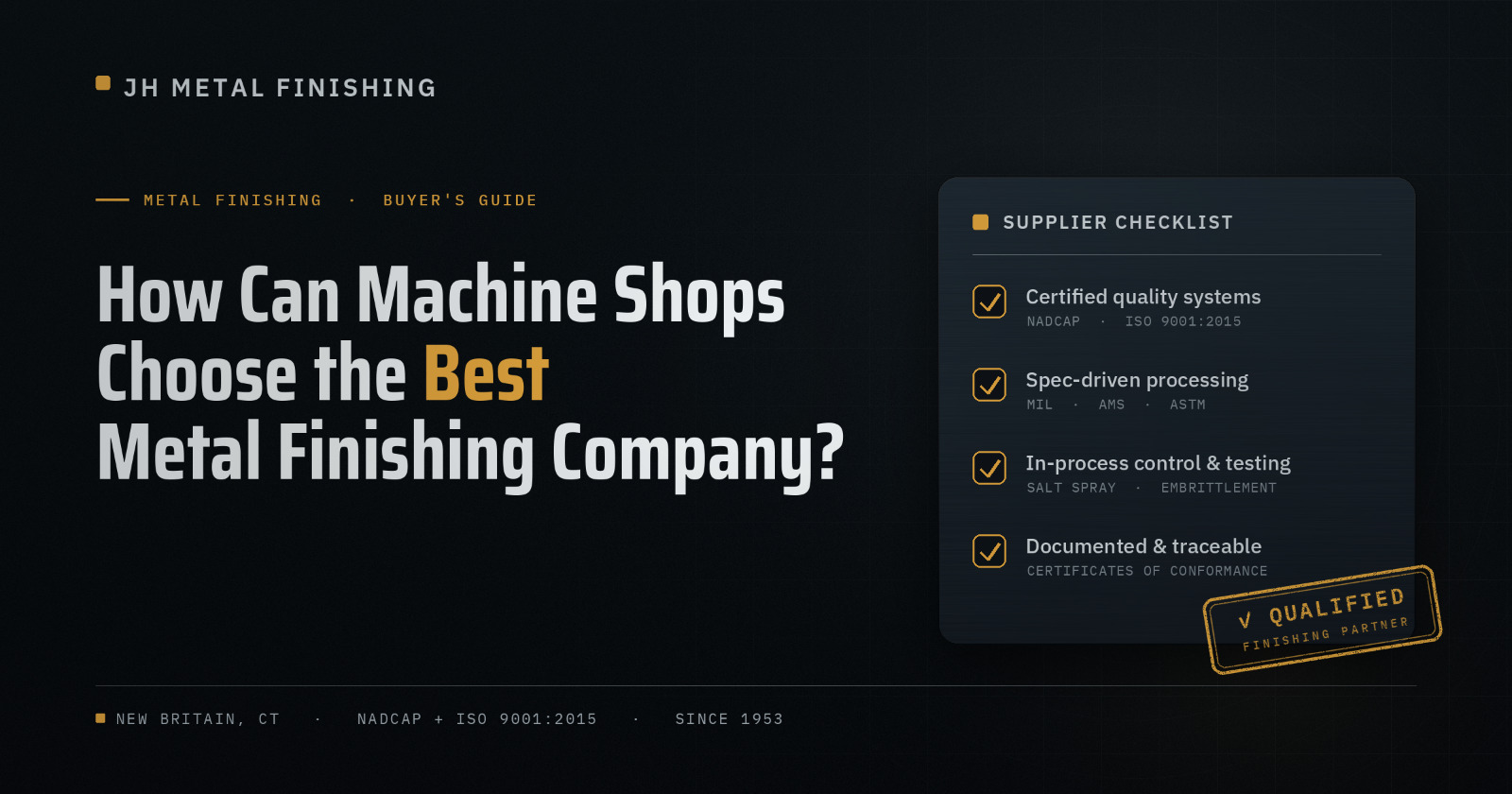
What Should Machine Shops Look for in a Metal Finishing Company?
The ability to meet the exact specification
In-house processing capabilities
Current ISO and Nadcap certifications
Certificates of conformance and lot traceability
Consistent results across repeat orders
Controlled bath chemistry and process monitoring
Realistic capacity and turnaround commitments
Direct, honest communication
Experience with demanding industries
Local pickup and delivery options
01.
When Does Choosing a Local Connecticut Metal Finishing Company Matter?
You machined the parts. The tolerances are held, the features are clean, and the lot is ready to move. Now the drawing calls for black oxide, or phosphate, or a passivation spec, and that work happens somewhere else. Picking who does it is not a small decision. From the moment those parts leave your dock, the finisher is an extension of your shop. Their quality becomes your quality. Their schedule becomes your schedule. And if something goes wrong in their tank, your name is on the packing slip when the parts reach your customer.
That is the real weight behind choosing a metal finishing company. You are not just buying a coating. You are handing off parts you have already added value to, and trusting someone else to send them back in spec, on time, with the paperwork to prove it.
JH Metal Finishing has been on the receiving end of that handoff since 1953. For most of those years the work came the way it still often does in this trade, through relationships and word of mouth, one machine shop telling another who they trust with their parts. That kind of reputation is earned slowly and lost quickly, which is a useful lens for evaluating any finisher, including this one. This article lays out what actually matters when you make the choice, roughly in the order it should matter.
02.
Can They Hit Your Exact Specification?
Start with the only question that is truly non-negotiable: can this shop meet the specification on your print, exactly as written, and prove it?
Finish callouts are not suggestions. A drawing that calls for MIL-DTL-13924 for black oxide, MIL-DTL-16232 Type M for manganese phosphate, or ASTM A967 for passivation names a specific process with defined acceptance criteria. A finisher who treats those callouts loosely, or who says they can "basically" do what the spec asks, is a risk you inherit. The right response to a spec is a shop that reads it the way you read a print, knows the class and type variations inside it, and can tell you when a callout is outdated or ambiguous before parts go in the tank, not after.
This is also where you confirm the shop actually runs the process you need in-house, rather than quietly sending it out to a third party you never evaluated. Ask directly. A finisher that subcontracts a step is not automatically wrong, but you have a right to know where your parts go and who else touches them, because that hidden vendor is now part of your supply chain too.
Match the process to the part, not to habit. Black oxide adds almost no dimensional buildup, which is why it survives on tight-tolerance work where plating thickness would push a feature out of spec. Manganese phosphate holds oil and fights galling on sliding and threaded parts. Zinc phosphate is a paint and corrosion base. Passivation restores the corrosion resistance of stainless by removing free iron, without adding a coating at all. A capable shop will talk through these trade-offs instead of steering every job toward whatever is easiest to run, and will be honest when a finish is not the right fit for your part, even when that means less work for them.
03.
Certifications and Documentation That Hold Up
A certificate on the wall is only worth what it lets you prove to your own customer.
Two credentials do most of the work in this industry. ISO 9001:2015 says the shop runs a documented quality management system. Nadcap, the aerospace and defense industry's accreditation for special processes, says the shop's chemical processing has been audited against a much more demanding, process-specific standard. If your customer flows down a Nadcap requirement, a finisher without it cannot legally close the loop on your part, no matter how good the coating looks.
Do not stop at the logo. Nadcap and ISO are both granted for a defined scope, so verify that the accreditation actually covers the process you are buying and that the certificate is current. You can confirm a supplier's Nadcap status and scope through the Performance Review Institute's online database, and any reputable finisher will hand you current certificates without hesitation. JH Metal Finishing holds Nadcap accreditation for chemical processing alongside ISO 9001:2015, and publishes its current certificates and expiration dates, which is the kind of transparency you want to see before parts ship, not after.
Then there is the paperwork that rides with the parts. Certificates of conformance, first article inspection reports when required, lot traceability, and test records are what let you answer your customer months later when they ask whether a given lot met spec. In specification-driven work, if it isn't documented, it didn't happen. Ask any finisher how they handle certs, traceability, and first article requirements, and how quickly they can reproduce records for a past lot. Vague answers here are a warning.
One honest caution that runs counter to a lot of marketing. If your work involves parts on the U.S. Munitions List, ITAR obligations flow down the entire supply chain, and a finisher handling those parts or the associated drawings generally needs its own registration with the State Department's Directorate of Defense Trade Controls, since a prime's registration does not cover a subcontractor. This is worth raising directly with any finisher, JH included. For most defense and commercial finishing, that is a non-issue, but if your specific program carries ITAR flowdown, confirm the finisher's status rather than assume it.
04.
Consistency Is Harder Than a Good First Batch
Almost any shop can nail a sample or a first article. The finisher worth keeping is the one whose hundredth lot looks exactly like the first.
The failure mode that quietly wrecks supplier relationships has a name in procurement circles: quality fade. The first approved batch is clean, and then standards drift. A step gets skipped, a bath runs long, an unannounced subcontractor slips into the process, and the coating that passed in January is marginal by June. You often do not catch it until a customer does, which is the worst possible place to find out.
Process discipline protects you, not promises. Controlled bath chemistry, documented process parameters, in-process checks, and real inspection against the spec are what make lot one and lot fifty match. This is also why certified quality systems matter in practice. The value of ISO and Nadcap is not the certificate; it is that they force the repeatability and record-keeping that make consistency possible. When you evaluate a finisher, ask what they measure during a run and how they catch a drifting process before parts ship; then verify the answer with a trial lot and by watching how the second and third orders compare to the first.
Controlled bath chemistry, documented process parameters, in-process checks, and inspection against the specification.
05.
Capacity and Turnaround You Can Build a Schedule On
Your delivery date to your customer is only as reliable as your slowest supplier. A finisher that overpromises on capacity is not doing you a favor; they are setting up a broken promise you will have to explain downstream.
The distinction to listen for is committed capacity versus best-case capacity. A shop describing what it can do on a perfect week, with every line running and no other customers competing for the same tank, is telling you something close to fiction. What you want is a realistic, written lead time and a shop honest enough to tell you when a spike in your volume will stretch it. Ask how they handle a rush, what a typical turnaround looks like for your specific process, and what happens to your job when a bigger customer's order lands the same week.
You can also make turnaround more reliable on your side. Finishers plan capacity around what they can see coming, so a rough forecast of upcoming volume, even an imperfect one, lets a shop reserve tank time and staffing instead of scrambling. The best finishing relationships treat the finisher as part of your production plan, not a last-minute pressure valve.
06.
Communication When Something Changes
Specs get revised. Schedules move. Parts occasionally come back wrong. What separates a dependable finisher from a painful one is what happens in those moments.
You want direct access to someone who understands the work, not a sales rep relaying messages to people you never speak with. When a drawing revision lands, can you reach a person who will tell you whether it changes the process or the price? When your customer pulls a delivery forward, will the finisher tell you honestly whether the new date is achievable, or agree and miss it? And when a lot has a problem, does the shop call you early, explain what happened, and work on corrective action, or do you find out when the parts show up late and short?
Early, honest communication about bad news is worth more than cheerful communication about good news. A finisher who flags a risk to your date a week out gives you room to manage your customer. One who goes quiet until the deadline leaves you exposed. In a business built on repeat work and referrals, the finishers who last are usually the ones who are straight with you when something goes sideways.
07.
Experience With Demanding Work Raises the Floor for Everyone
Not every machine shop makes aerospace or defense parts. But it is worth understanding why experience with those industries matters even if your work is commercial or industrial.
Aerospace and defense finishing forces a level of process control, documentation, and traceability that most general finishing never demands. A shop that has spent decades meeting those requirements builds habits, inspection routines, record-keeping, and disciplined prep, that carry over to every job it runs, including yours. The reverse is also true. A finisher casual about surface preparation, degreasing, and cleanliness will struggle with demanding work no matter what its brochure says, because a coating is only as good as the surface underneath it. A shop's track record on the hardest work it does is a fair proxy for the care it brings to the routine work, which is one reason JH's long history with defense, aerospace, automotive, and industrial customers is worth weighing as a signal of the disciplines it has had to internalize.
08.
Geography: Local Is an Advantage, Not a Default
This is where many machine shops get it backward. Proximity is genuinely valuable, but it is a tiebreaker, not a starting point. A finisher down the road that cannot hold your spec, document its work, or deliver consistently is worse than a qualified shop an hour away. Capability, specification compliance, and reliability come first, every time. Never pick a finisher because it is close and hope the quality follows.
Once a shop clears that bar, though, location earns a real place on your scorecard, and in Connecticut that advantage is unusually concrete. This is one of the most concentrated advanced-manufacturing regions in the country. The state is home to more than 4,500 manufacturers, has the highest concentration of advanced-manufacturing workers in the nation, and sits at the center of an aerospace and defense supply chain so dense that the greater Hartford area is nicknamed "Aerospace Alley." Connecticut alone accounts for more than 23 percent of all U.S. aircraft engine and parts production. For a machine shop here, the people who machine, finish, inspect, and assemble your parts are often just a short stretch of highway away.
That density changes the freight math. A part frequently moves more than once, out to finishing, sometimes back for inspection, then on to assembly, and every leg carries cost, packaging, handling time, and a small but real risk of a nick, a scratch, or a mixed lot that turns precision parts into scrap. Shipping finished parts across the country multiplies all of it and adds days you cannot control to your lead time. A nearby finisher shortens that loop, and one that offers pickup and delivery, as JH does within its service area, removes a layer of freight and handling entirely. Your parts stay in a tighter, more controlled circle, your schedule depends on fewer outside carriers, and when a problem comes up, the shop is close enough to walk a part across town rather than launching a shipping investigation.
A finisher in your region also tends to understand the customers, the specs, and the pace of Connecticut manufacturing because it lives in the same ecosystem, and that shared context reduces friction from quoting to problem-solving.
09.
Putting It Together
The order is what matters. Confirm the shop can meet your exact specification and prove it. Check that its certifications actually cover your process and that its documentation will hold up when your customer asks. Test for consistency beyond the first batch. Make sure its capacity and lead times are real, not best-case. Judge how it communicates when something changes, and weigh its experience against the hardest work it does. Only then, once a finisher has cleared all of that, let proximity, pickup and delivery, and responsiveness break the tie, which in a corridor as tightly wound as Connecticut's can genuinely tighten your schedule and cut your risk. None of this is exotic. It is the same judgment you already apply to your own customers, turned around and pointed at a supplier.
If you are weighing a finisher for parts coming off your floor, or you want to talk through a specific print, a finish callout, a turnaround you have to hit, or whether pickup and delivery would simplify your logistics, JH Metal Finishing is glad to have that conversation. Send the drawing, describe the parts, and we will tell you honestly what they need and how we would handle them.
Connecticut Metal Finishing Company
Send Us Your Drawing
If you are evaluating a finisher for parts coming off your floor, send the print, finish callout, quantity, and schedule requirements to JH Metal Finishing.