
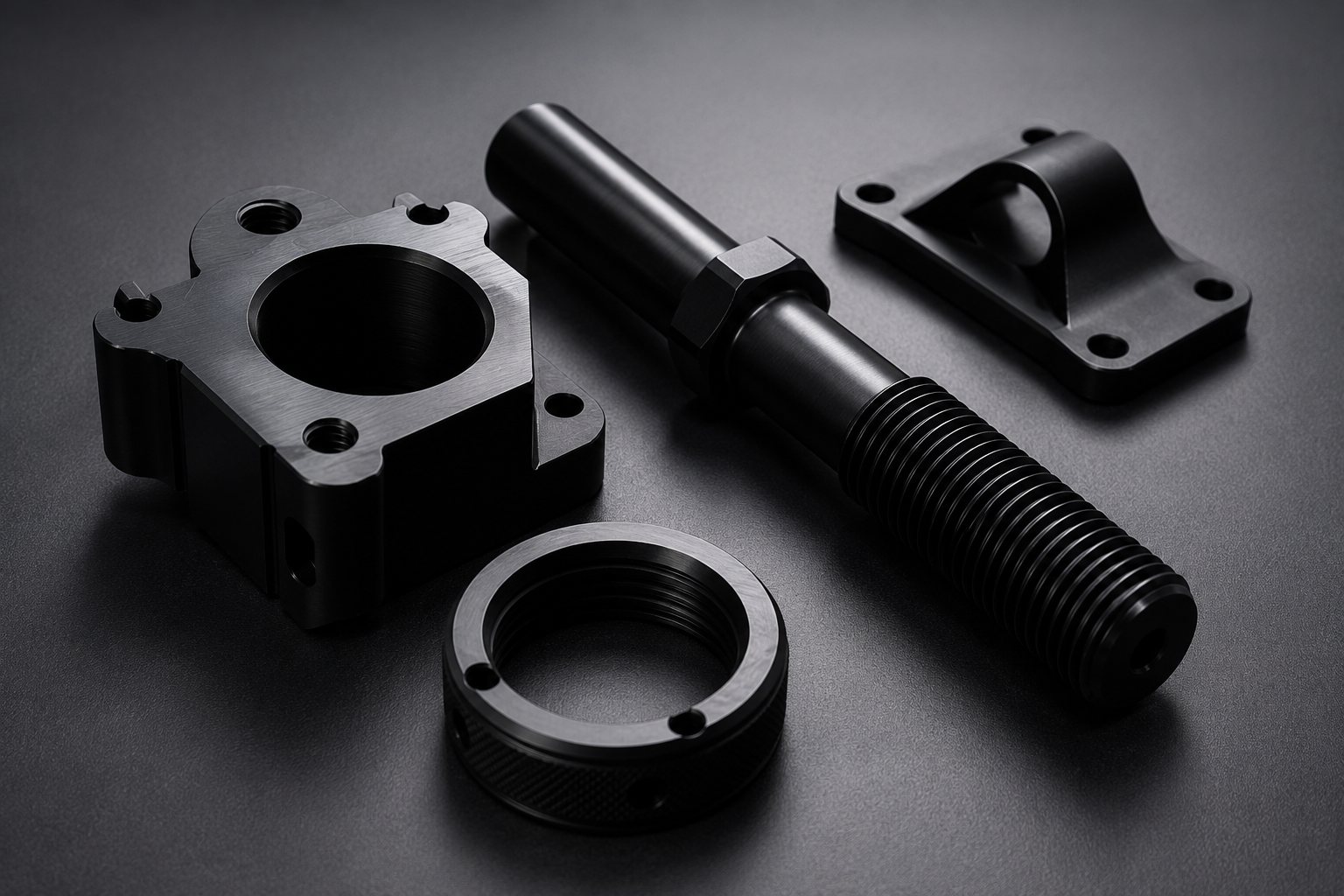
Three Questions to Ask Before Choosing a Conversion Coating
What does the finished part actually have to do?
A coating should match the application, not just the drawing. Parts that slide, carry heavy loads, or experience repeated friction have very different finishing requirements than parts that simply need a clean appearance or a good surface for paint.
Which performance characteristic matters most?
Wear resistance, corrosion protection, dimensional stability, paint adhesion, and lubricant retention all point toward different finishing processes. Understanding the primary goal helps narrow the choice between manganese phosphate, black oxide, and zinc phosphate.
What specifications must the finish satisfy?
Military, aerospace, and commercial drawings often reference standards such as MIL-DTL-16232, ASTM B117, or Nadcap requirements. Selecting the proper finish means meeting those specifications while delivering the performance the application demands.
01.
How Engineers and Purchasing Managers Can Make the Right Choice
When comparing manganese phosphate vs black oxide or zinc phosphate, the right choice depends on wear resistance, corrosion protection, lubricant retention, and the specification the part must meet.
Choosing a metal finish looks like a small line item on a drawing. In practice, it is one of the decisions that quietly controls how a part performs. The finish you specify affects wear resistance, corrosion protection, how often the part needs maintenance, how long it lasts in service, and the overall cost of the job. Pick the wrong one, and you can end up with parts that gall, seize, rust in storage, or fail a customer's salt spray requirement after you have already shipped.
Three finishes come up again and again for steel parts, and they are easy to confuse because they can all look dark and all fall under the heading of conversion coatings: manganese phosphate, black oxide, and zinc phosphate. They are not interchangeable. Each one exists to solve a different problem.
This article walks through what each finish actually is, how they compare on the factors that matter, and, most importantly, when manganese phosphate is the right choice over the other two. JH Metal Finishing has been finishing steel parts for defense, aerospace, automotive, and machine shop customers in New Britain, Connecticut, since 1953, and a large part of the job is helping engineers and buyers match the finish to the application before parts ever hit the tank. The goal here is to give you enough understanding to make that match with confidence.
02.
First, What Is a Conversion Coating?
Before comparing the three, it helps to understand what they have in common. A conversion coating is not a layer of material added to the part, as paint or plating is. Instead, the steel's surface is chemically converted into a new compound. The finish grows out of the metal rather than sitting on it.
This matters for two practical reasons. Conversion coatings add very little thickness, so they rarely disturb tight tolerances, and because they are part of the surface, they tend to adhere extremely well. Where the three finishes differ is in what they convert the surface into, how thick and porous the result is, and therefore what job the finish is good at.
03.
Black Oxide: A Thin Black Surface With Almost No Buildup
Black oxide finish is a chemical conversion that turns the surface of ferrous metal into magnetite, a black iron oxide. It is produced by immersing parts in a hot alkaline salt solution. The finish is extremely thin, on the order of five to ten millionths of an inch, which is why engineers reach for it when they need a black surface with essentially no dimensional change. The common military specification is MIL-DTL-13924, with the related aerospace standard AMS 2485.
Here is the key thing to understand about black oxide: on its own, it provides only very limited corrosion protection, and only under mild conditions. The black oxide layer is slightly porous and does not prevent rust on its own. Corrosion resistance comes almost entirely from a supplementary treatment, usually a rust preventive oil or wax that soaks into the surface and seals it. Without that oil or wax, bare steel under black oxide will begin to rust quickly in humidity.
Black oxide earns its place through appearance and dimensional stability. It provides a clean, uniform black finish that also reduces glare, which is useful for optical and sighting components. It reduces light reflection, it does not change the hardness of heat-treated steel, and it leaves precision features alone. That is why it shows up on gun barrels, munition cases, fasteners, gauges, tooling, and small moving parts where even a fraction of a thousandth of buildup would be a problem.
04.
Zinc Phosphate: The Finish Built for Paint and Corrosion Pretreatment
Zinc phosphate coating is also a conversion coating, but it grows a crystalline phosphate layer on the steel rather than an oxide. It falls under MIL-DTL-16232 Type Z and the aerospace standard AMS 2480. Its crystals are relatively fine and tightly packed.
Zinc phosphate is not usually chosen as a standalone finish. Its strength is acting as a base for something else, most often paint or powder coating. The phosphate layer gives paint a rougher, chemically friendly surface to grab onto, which dramatically improves adhesion and helps prevent corrosion from creeping under the paint film later.
It has a second common use in metal forming. The phosphate layer holds drawing and forming lubricants, which reduce friction and extend die life during cold-forming operations such as wire drawing. So when the goal is paint adhesion, corrosion protection under a coating, or a lubricant carrier for forming, zinc phosphate is typically the answer.
05.
Manganese Phosphate: The Wear and Lubrication Specialist
Manganese phosphate coating is the third conversion coating, and it is the reason this article exists. It falls under MIL-DTL-16232 Type M, with the aerospace standard AMS 2481. Like zinc phosphate, it grows a crystalline layer, but the crystals are heavier, coarser, and more porous.
That porosity is the whole point. The rough, sponge-like crystal structure acts as a reservoir. It holds oils, waxes, and dry lubricants far better than the finer zinc phosphate or the very thin black oxide can. On a microscopic level, the finish provides a place for lubricant to reside, so the lubrication stays where it is needed under load.
Manganese phosphate also provides genuine wear resistance and anti-galling behavior. When two steel surfaces slide against each other, they can gall, which means they grab, tear, and seize. The manganese phosphate layer prevents the two metal surfaces from making direct contact and carries lubricant into the contact zone. This is exactly what you want during the break-in period of a new mechanical assembly, when surfaces are seating against each other for the first time.
You may hear manganese phosphate called Parkerizing, especially in the firearms world, or Parco Lubrite as a trade name. They refer to the same family of heavy manganese phosphate finishing.
06.
How They Compare on the Factors That Matter
It is easier to choose once you line the three up against the decisions you actually make.
Wear resistance
Manganese phosphate is the clear leader. Its crystal structure resists galling and seizing and holds lubricant under load. Black oxide offers modest help against galling when oiled, but it is thin and not a true wear coating. Zinc phosphate is not chosen for wear.
Corrosion protection
None of these three finishes is a strong corrosion barrier on its own. All of them rely heavily on a supplementary oil, wax, or topcoat for real protection. Zinc phosphate performs best specifically as a base under paint. Manganese phosphate sealed with the right oil performs well, and black oxide gives the least protection on its own.
Oil retention
Manganese phosphate wins by a wide margin because of its porosity. This is its signature strength and the main reason it gets specified for demanding, high-wear parts.
Appearance
Black oxide gives the deepest, most uniform black and is often chosen for looks and glare reduction. Manganese phosphate ranges from dark gray to black but has a duller, more textured look. Zinc phosphate is typically gray and is rarely chosen for appearance at all.
Dimensional buildup
Black oxide adds almost nothing, which is its calling card for precision parts. The two phosphates add thickness because they form a heavier crystal layer, so they need to be accounted for in very tight tolerances.
Cost
All three are cost-effective compared with plating or ceramic coatings. Black oxide is generally the lowest cost. The phosphates cost a bit more due to heavier coatings and the supplementary treatments they usually require, but they remain economical for the performance they deliver.
07.
Quick Comparison
| Factor | Manganese Phosphate MIL-DTL-16232 Type M |
Black Oxide MIL-DTL-13924 |
Zinc Phosphate MIL-DTL-16232 Type Z |
|---|---|---|---|
| Primary strength | Wear resistance and lubricant retention | Black appearance with no buildup | Paint base and forming lubricant carrier |
| Oil and dry film retention | Excellent, porous crystal structure | Limited | Moderate |
| Corrosion protection | Good when sealed with oil or dry film | Very limited, needs oil or wax | Best under paint |
| Appearance | Dark gray to black, textured | Deep uniform black, low glare | Gray, not decorative |
| Dimensional buildup | Moderate | Almost none | Moderate |
| Relative cost | Moderate | Lowest | Moderate |
| Ideal for | Firearms, gears, cams, high wear defense parts | Precision and optical parts, fasteners, tooling | Parts to be painted or cold formed |
08.
Why Manganese Phosphate Dominates in Firearms and Defense
If you look at military and commercial firearm components, you'll find manganese phosphate everywhere. There is a good engineering reason for that, and it comes back to lubrication under punishing conditions.
Firearms and ordnance parts see heat, friction, repeated cycling, and exposure to weather and solvents, and they get cleaned and re-oiled constantly. A finish on these parts needs to hold lubricant throughout all that, resist wear where parts slide and lock, and not build up in a way that changes fit. Manganese phosphate does all three. Its porous surface keeps oil in the contact areas, its wear resistance protects sliding surfaces, and it provides a slightly non-reflective dark finish that the military often prefers.
This is where the relevant specification, MIL-DTL-16232 Type M, is useful for understanding rather than just citing. The specification covers heavy manganese phosphate coatings for ferrous parts and, importantly, treats the phosphate as a base that supports a supplementary treatment that provides the major portion of the corrosion resistance.
In other words, the spec is built around the idea that manganese phosphate and a topcoat work together. The specification breaks Type M into classes based on the supplementary treatment applied, allowing a designer to call out exactly the combination the part needs.
09.
Supplementary Oils and Dry Film Lubricants: The Other Half of the System
Because the phosphate is designed to hold a topcoat, the choice of topcoat is part of the decision.
Supplementary oils are preservative and lubricating oils that soak into the phosphate and provide corrosion protection along with lubrication. Common specifications include MIL-PRF-3150 and MIL-PRF-16173, Grade 3, which is a water-displacing preservative. When a manganese phosphate part is sealed with one of these oils, its corrosion resistance rises sharply compared with the bare coating. JH Metal Finishing offers these supplemental rust-preventive oil treatments in-house, so the phosphate and its seal can be applied as a single controlled process.
Dry film lubricants are another common partner, and this is a big reason manganese phosphate is specified. A dry film lubricant, often covered by MIL-PRF-46010, is a heat-cured solid film, usually based on molybdenum disulfide or graphite, that bonds to the surface and provides lubrication without any oil at all. It is the right choice for sliding parts like bearings, hinges, cams, splines, and threads, and for situations where oil cannot be used because it would attract dirt and dust or cannot be reapplied over the life of the part. Dry film lubricants also hold up across a very wide temperature range.
Here is the connection that ties it together. Dry film lubricants need something to grip, and manganese phosphate is the preferred base coat. The porous phosphate anchors the solid film so it lasts far longer than it would on bare steel. Applying a dry film lubricant over a manganese phosphate base can meaningfully improve salt spray performance, which is why the two are so often specified together on defense hardware. If your drawing calls for a dry-film lubricant on a steel part, there is a strong chance that manganese phosphate is beneath it.
Manganese phosphate and the supplementary oil or dry film should be treated as a complete system, not as separate finishing decisions.
10.
How Corrosion Performance Actually Gets Verified: ASTM B117
When a customer specifies a corrosion requirement, they usually point to ASTM B117 salt spray testing, the standard salt-spray or salt-fog test. One of the more common calls we receive is from purchasing managers who only know that the drawing says “48-hour salt spray.” We can usually work backward from that requirement and recommend the correct coating and supplementary treatment.
This is worth understanding because it is how the finish and its topcoat get judged in practice. Parts are placed in a sealed chamber and exposed to a continuous fine mist of salt solution, then examined for corrosion. Results are reported in hours before rust appears.
Bare manganese phosphate on its own passes only a short exposure. Sealed with a preservative oil under MIL-DTL-16232 Type M, Class 2, the requirement rises to a minimum of 48 hours of salt spray.
With a dry-film lubricant topcoat, phosphate systems typically target around 100 hours. The number your customer needs will determine whether you specify oil, a dry-film lubricant, or another topcoat over the phosphate. JH Metal Finishing performs ASTM B117 salt spray testing in-house, which means the corrosion performance you promised can be verified before parts leave the building rather than discovered at your customer's dock.
11.
Why Nadcap Accreditation Belongs in This Conversation
For defense and aerospace work, it is not enough to apply the right finish. Many aerospace buyers do not actually have a choice. Their customer requires a Nadcap-accredited processor. You have to prove the process was controlled. That is what Nadcap addresses.
Nadcap metal finishing, through the National Aerospace and Defense Contractors Accreditation Program, is an industry-managed accreditation program for special processes such as coating and finishing. A Nadcap audit examines the actual process controls, chemistry management, testing, and documentation behind the finish, not just the finished part.
For a purchasing manager or quality engineer, this matters because many primes and defense contracts flow down a Nadcap requirement. Sending parts to a finisher that is not accredited may mean they are not acceptable, no matter how good they look. JH Metal Finishing is Nadcap-accredited and ISO 9001:2015 certified, and supports specification-driven work through pre-process drawing review, in-process checks, and certificates of conformance. For regulated work, that documentation is often as important as the coating itself.
12.
Real-World Examples
Choose Manganese Phosphate
Choose manganese phosphate when you have a steel component that slides, locks, or wears against another surface and needs to retain lubricant, especially with dry film lubricant. A firearm slide or bolt carrier, a camshaft, a gear, or a heavily loaded fastener on defense hardware are classic cases. If the drawing calls for MIL-DTL-16232 Type M, or a MIL-PRF-46010 dry film lubricant on steel, this is your finish.
Choose Black Oxide
Choose black oxide when you need a clean black appearance or reduced glare with essentially no dimensional change, and the part lives in a mild environment or will be oiled. Precision gauges, tooling, optical housings, small fasteners, and sighting components fit here. It is the economical choice when looks and tight tolerances matter more than heavy wear or corrosion.
Choose Zinc Phosphate
Choose zinc phosphate when the finish is a stepping stone to paint or powder coat, or when you need a lubricant carrier for cold forming. A steel bracket or housing that will be painted, or a part being drawn or formed, is a natural fit. If the goal is paint adhesion and under-film corrosion protection, zinc phosphate is the standard base.
13.
A Simple Decision Guide
Start with the primary job that the finish has to do.
Does the part slide, wear, carry a load, or need to hold lubricant?
If a dry film lubricant is involved, specify manganese phosphate.
Do you need a black, low-glare surface with no meaningful dimensional change?
Specify black oxide and plan on an oil or wax seal.
Is the finish a base for paint, powder, or a carrier for forming lubricant?
Specify zinc phosphate.
Then confirm two things. Match the supplementary treatment, whether oil or dry film lubricant, to the corrosion target your customer set under ASTM B117. And if the work is defense or aerospace, make sure it runs through a Nadcap-accredited process, with supporting documentation.
14.
Where to Go From Here
The honest short answer to the title question is this. Specify manganese phosphate instead of black oxide or zinc phosphate when your steel part has to resist wear and hold lubricant in a demanding, high-contact environment, which is exactly why it dominates firearms and defense hardware. Reach for black oxide when appearance and tolerances matter, and for zinc phosphate when paint or forming matter.
If you are weighing these options for a specific part, or trying to meet a military, commercial, or customer specification and are not certain which finish and topcoat combination will get you there, that is a good time to bring in a finisher early. JH Metal Finishing helps manufacturers, engineers, and purchasing teams select the right finish for the application, then processes it to meet MIL, AMS, ASTM, and customer requirements, with testing and documentation to prove it. Send over a drawing or an RFQ, and the team can help confirm the finish before the first part is ever coated.
Need Help Choosing a Conversion Coating?
Send Us Your Drawing or RFQ
Our team can help confirm the correct finish, supplementary treatment, specification, and testing requirements before production begins.